Our Biosolids treatment project
Our current process

 Why is this project needed?
As part of the wastewater treatment process, solids are separated from wastewater. These solids are known as biosolids.
At the Lower Molonglo Water Quality Control Centre, biosolids are currently processed using infrastructure that has been operating since the 1970s. While these assets continue to play an important role, they are approaching the end of their service life, are becoming increasingly costly to maintain, and lack the capacity needed to support Canberra's growing population.
Renewal of this infrastructure will support ongoing reliability while helping meet Canberra's future growth and wastewater treatment needs.
What are we doing?
We are planning a new biosolids treatment facility that will provide a sustainable, reliable and efficient solution for managing Canberra's biosolids for decades to come.
Technology assessment update
Over recent years, we assessed a range of biosolids treatment technologies to identify the most suitable long-term solution for Canberra. The initial planning stages of the project identified gasification as the preferred technology for further investigation. Through the planning process, additional technical investigations, operational learnings, market analyses and risk assessments were completed.
Most major infrastructure projects evolve as more information becomes available, enabling sound & informed decision making in the project development phases.
As additional information became available through project planning, and by monitoring performance, maturity and suitability of the initially preferred technology, we undertook a further evaluation of available technology pathways.
Based on this work, advanced thermal treatment technology, such as Fluidised Bed Thermal Conversion (FBTC), was identified as the preferred pathway for further development and detailed design.
Further assessments indicated that advanced thermal treatment technologies provide the most appropriate balance of reliability, environmental performance, resource recovery and long-term operational certainty for Canberra's future needs. The revision of technology will allow us to meet project and Icon Water requirements and expectations.
What are the benefits?
The preferred thermal treatment pathway is expected to:
- replace ageing infrastructure
- improve reliability and operational performance
- support ongoing resource recovery and circular economy outcomes
- provide flexibility to respond to future environmental and regulatory requirements
- assist in managing contaminants of emerging concern
- support efficient and sustainable long-term service delivery
- support Canberra's growing population
- provide value for money through long-term infrastructure investment.
What happens next?
The project will continue through planning and early contractor involvement activities to further develop the design of the preferred treatment technology pathway.
We will continue to provide updates and engage with stakeholders as the project progresses.
Project timeline for bioreactor and biosolids
2022
- Early community and stakeholder consultation on the shortlisted options.
- Icon Water expert panel examines the options and the process of assessment.
- Icon Water Board approval of the preferred project options.
2023
- Broader community and stakeholder consultation on the selected option for each project.
- Delivery planning commences for both projects.
2024
- Community and stakeholder consultation continues.
- Establishment of major projects delivery partnership for design and construction of bioreactor and biosolids projects.
- Environmental studies and DA for bioreactor.
2026
- Review of biosolid options considering current technological and legislative status, and selection of shortlist.
2025 - 2029
- Bioreactor's design, construction and commissioning.
- Updates to stakeholders and the community.
2028 - 2032
- Biosolid's design, construction and commissioning.
2030
- Bioreactor project complete.
2033
- Biosolids project complete.
FAQs
Why has the preferred technology changed?
Earlier stages of the project identified gasification as the preferred technology for further investigation.
As planning progressed, additional technical investigations, operational learnings, market analysis and risk assessments were completed. Based on this updated information, advanced thermal treatment technology was identified as the preferred pathway for further development.
What is thermal treatment?
Thermal treatment uses high temperatures to safely process biosolids.
This process helps reduce contaminants and pathogens while supporting resource recovery and long-term environmental outcomes.
What are biosolids?
Biosolids are the organic solids that are separated from wastewater during the treatment process.
When wastewater arrives at our treatment plant, it goes through several stages of treatment where materials are removed, and the water is cleaned before being safely returned to the environment. During this process, solids such as organic matter, particles that settle out of wastewater, and excess microorganisms used in the treatment process are collected and treated. These materials are known as biosolids.
What are contaminants of emerging concern?
Contaminants of emerging concern are substances that are receiving increased attention.
Examples can include PFAS, microplastics and some pharmaceutical compounds.
The preferred thermal treatment pathway is expected to support the management of these contaminants while delivering broader environmental and public health benefits.
How was the technology selected?
After carefully assessing 17 options, five were shortlisted. These shortlisted options would provide a reliable service that continues to protect human health and the environment. They would also help maximise resource recovery by producing energy or providing us with a product that can be re-used (like Agri-Ash).
As more detailed information became available, the preferred pathway was refined to ensure the best long-term outcome for Canberra.
Our options:
Of the 17 options that we carefully assessed, five have been shortlisted:
- Option 1: Fluidised Bed Thermal Conversion (FBTC)
This option is similar to our existing furnaces (by using intense heat) but is much more efficient and reliable. FBTC may produce excess energy which can be repurposed for other uses. It also creates an ash like the Agri-Ash we are already producing - Option 2: Anaerobic Digestion (AD)
This option processes the solids from wastewater using anaerobic biological processes. The biosolids produced by this process can be used on farmland. The methane produced can either be converted into electricity or used to dry biosolids. - Option 3: AD plus external biodegradable waste streams
This process is like Option 2, but it is amplified by extra waste streams from local industry. This helps others by taking their waste and creates more electricity from methane. - Option 4: AD plus off-site composting
This process is the same as Option 2, except it includes processing waste off site at a third-party composting facility. This composted product can be used on gardens or farmland. - Option 5: Gasification
This option is like Option 1, but combustion occurs in a low oxygen environment. The product from this process is a biochar which may be more beneficial to agriculture than Agri-Ash because of its higher organic content.
Options assessment:
These options went through a robust multi-criteria analysis to make sure we chose the best solution that considered cost, the needs of our community, our environment and factored in circular economy opportunities.
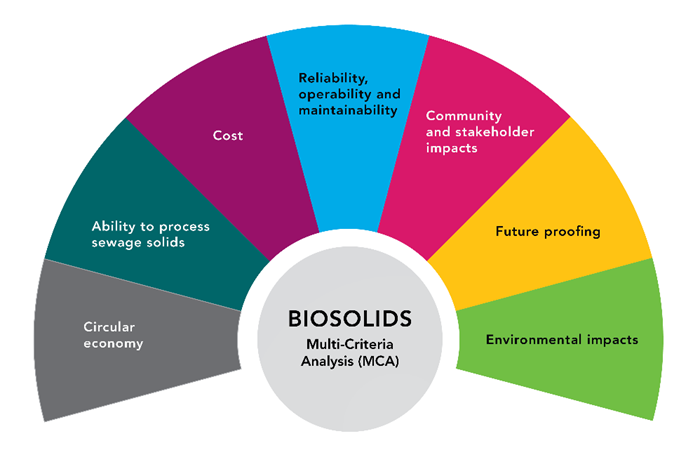
After rigorous assessment of suitable options, advanced thermal treatment technology, such as Fluidised Bed Thermal Conversion (FBTC), has been identified as the biosolids treatment solution that will provide the greatest community and environmental outcomes.